Cold email
How to design a cold email follow-up cadence
A concise follow-up system that adds context across touches without repeating the original pitch or creating unnecessary pressure.
The short answer
How to design a cold email follow-up cadence
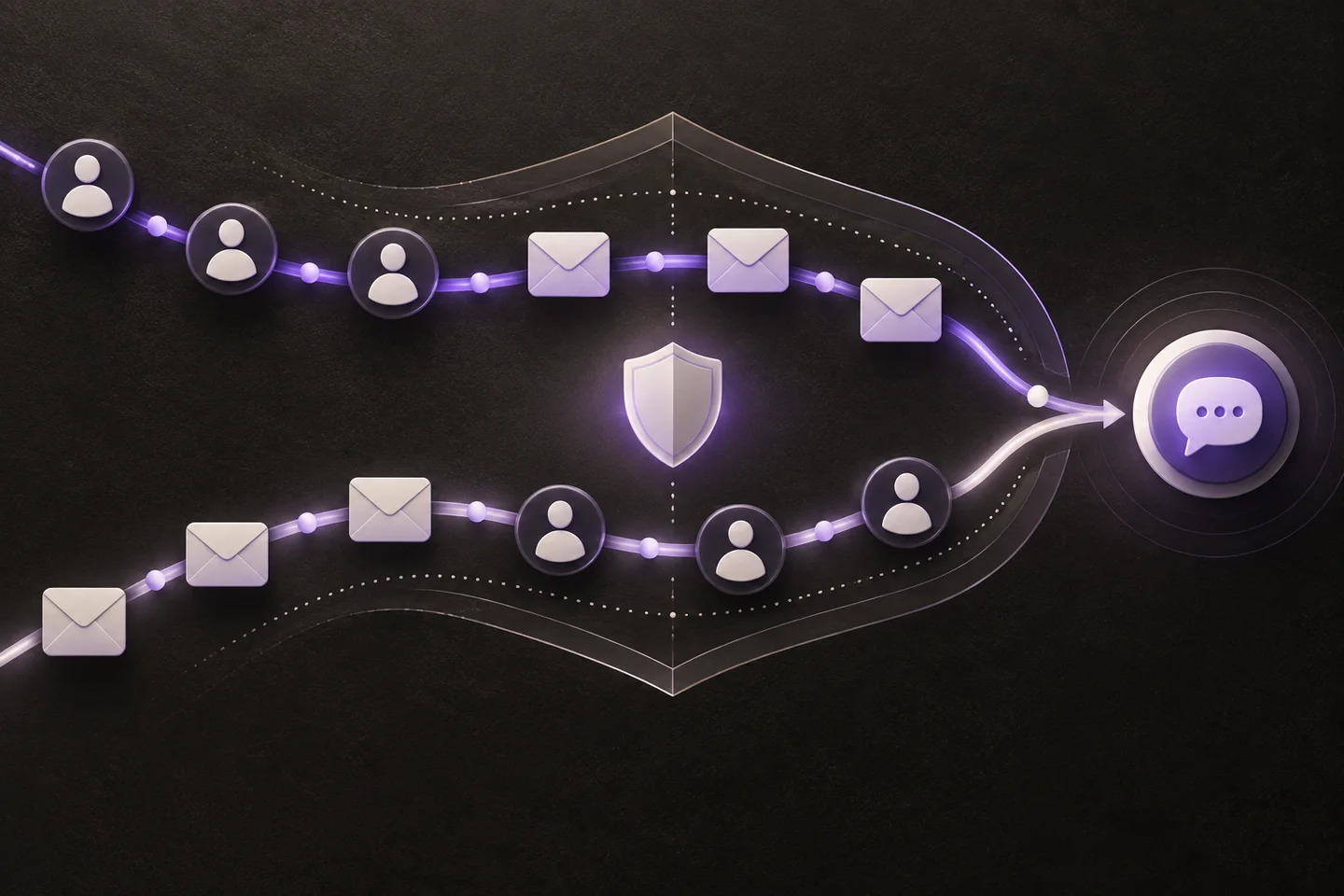
A useful cold email follow-up cadence gives the prospect enough time to see the message, introduces a new piece of context, and closes the loop respectfully. Every touch should advance the reason to respond instead of restating the same request.
This Seqnced field guide turns that principle into an operating decision. It explains what to define before execution, how Seqnced applies the approach across a real account universe, what to inspect while the campaign is live, and where teams most often lose commercial signal.
01
Give each follow-up a different job
The first message tests the core thesis. A second touch can clarify the use case, introduce proof, or add a relevant signal. The final touch can close the loop and leave a clear path to reconnect later. In Belkins' 2026 study of 7.5 million of its own outreach emails, follow-up steps 2 through 6 produced 58.6% of all replies, against 41.4% for the first email.
Changing greetings while repeating the same body is not a sequence. It is one message delivered several times.
02
Match timing to the market and channel
Enterprise and institutional buyers often need more time than transactional prospects. Build spacing around their likely workload and coordinate email with LinkedIn or warm calling when the account warrants it. Gong Labs, analyzing more than 300 million cold calls, found that leaving a voicemail raised email reply rates from 2.73% to 5.87%.
Stop when the prospect declines, asks for a later date, or becomes inappropriate for the campaign. Respectful suppression is part of good sequencing.
- Touch one: commercial thesis
- Touch two: proof or implementation context
- Touch three: new timing signal or useful resource
- Final touch: close the loop
Field guide
The decisions that connect the system
03
Judge the sequence by conversation quality
A follow-up can raise replies while lowering fit. Review positive responses, qualified meetings, objections, and opportunity progression by touch.
If later touches produce only irritation or weak meetings, shorten the sequence or improve the initial segment rather than assuming more persistence is required. The same study puts the practical range for most B2B sequences at 3 to 5 steps, with step 6 adding minimal incremental replies.
Application framework
Turn the idea into an operating plan.
A useful guide should change what the team does next. Convert each principle into a decision, an owner, and evidence that can be reviewed after the campaign reaches the market.
Changing greetings while repeating the same body is not a sequence. It is one message delivered several times.
Touch one: commercial thesis
If later touches produce only irritation or weak meetings, shorten the sequence or improve the initial segment rather than assuming more persistence is required. The same study puts the practical range for most B2B sequences at 3 to 5 steps, with step 6 adding minimal incremental replies.
What to measure
Evidence over activity.
- Inbox placement by provider
- Bounce and suppression rates
- Sending-domain health
- Positive replies per delivered message
Failure modes
Treating volume as the objective
Sending more from unhealthy infrastructure makes the problem larger. Protect the channel before increasing capacity.
Watching opens instead of conversations
Open tracking is noisy and can damage delivery. Replies, bounces, placement tests, and opportunity quality are more useful.
Changing every variable at once
If domains, lists, copy, and volume all change together, the team cannot isolate what improved or damaged performance.
Key takeaways
The decisions worth carrying forward.
- 01
Give each follow-up a different job: The first message tests the core thesis. A second touch can clarify the use case, introduce proof, or add a relevant signal. The final touch can close the loop and leave a clear path to reconnect later. In Belkins' 2026 study of 7.5 million of its own outreach emails, follow-up steps 2 through 6 produced 58.6% of all replies, against 41.4% for the first email.
- 02
Match timing to the market and channel: Enterprise and institutional buyers often need more time than transactional prospects. Build spacing around their likely workload and coordinate email with LinkedIn or warm calling when the account warrants it. Gong Labs, analyzing more than 300 million cold calls, found that leaving a voicemail raised email reply rates from 2.73% to 5.87%.
- 03
Judge the sequence by conversation quality: A follow-up can raise replies while lowering fit. Review positive responses, qualified meetings, objections, and opportunity progression by touch.
Key terms glossary
- Inbox placement
- The share of delivered messages that reach the primary inbox rather than spam or secondary folders.
- Suppression list
- A controlled record of contacts and domains that must not receive future outreach.
- Sending domain
- A domain used to operate outbound mailboxes while protecting the company's primary domain.
- Ramp
- A gradual increase in sending activity used to establish stable mailbox behavior.
FAQs
Questions teams ask before applying this.
What is the first step in how to design a cold email follow-up cadence?
The first message tests the core thesis. A second touch can clarify the use case, introduce proof, or add a relevant signal. The final touch can close the loop and leave a clear path to reconnect later. In Belkins' 2026 study of 7.5 million of its own outreach emails, follow-up steps 2 through 6 produced 58.6% of all replies, against 41.4% for the first email.
How should a team put this into practice?
Translate the idea into a written operating brief, apply it to a small and representative account segment, review the evidence, and expand only after the team can explain why the result occurred.
What should the team measure?
Measure commercial movement from reachable accounts through positive replies, attended conversations, qualified opportunities, and progression. Add the category-specific quality controls described above.
What is the most common mistake?
Sending more from unhealthy infrastructure makes the problem larger. Protect the channel before increasing capacity.
When should the approach be revised?
Revise it when response quality, objections, attendance, or opportunity progression contradict the original market or offer hypothesis. Change one meaningful variable at a time so the lesson remains visible.
Where does human judgment matter most?
Human judgment should remain responsible for the market thesis, proof, final positioning, sensitive replies, qualification decisions, and every conversation where trust or commercial commitment is at stake. Enterprise and institutional buyers often need more time than transactional prospects. Build spacing around their likely workload and coordinate email with LinkedIn or warm calling when the account warrants it. Gong Labs, analyzing more than 300 million cold calls, found that leaving a voicemail raised email reply rates from 2.73% to 5.87%.
Sources
Where the numbers come from.
Statistics and facts in this guide are taken from the publications below. Figures reflect each source at the time of review and may since have been updated.
Related Seqnced resources
See the capability, market, and proof behind the idea.
Put it into practice
Want this thinking applied to your market?
We build and run the outbound system, from the market thesis and account research through campaign execution and reply routing.
Explore managed B2B outbound systems →